
Appeal Against Rejection Of Interim Relief Cannot Be Remitted To Arbitral Tribunal: Supreme Court
Shivani PS
24 Sept 2026 6:14 PM IST
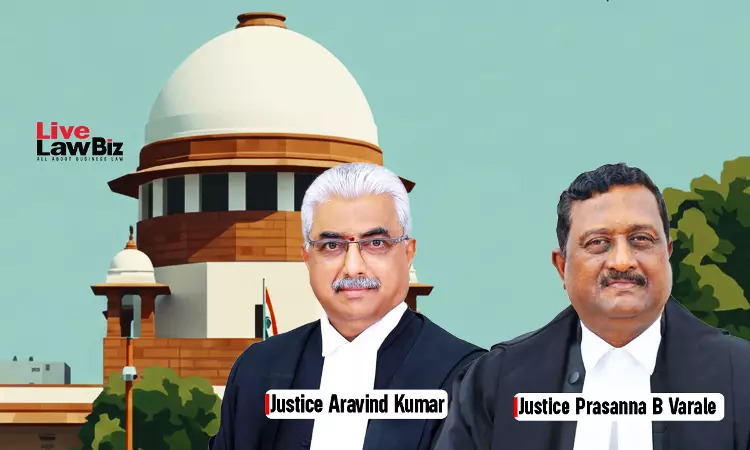
The Supreme Court has held that a High Court cannot transfer an appeal against rejection of an interim-relief application under the Arbitration and Conciliation Act to an arbitral tribunal and direct the tribunal to treat it as an application for interim measures.
A bench of Justice Aravind Kumar and Justice Prasanna B. Varale set aside a Bombay High Court direction to that extent in a dispute between the Union of India and Hariom Projects Pvt. Ltd.
"The appellate jurisdiction under Section 37 is vested exclusively in the “Court” as contemplated under Section 2(1)(e) of the Act. An Arbitral Tribunal exercising powers under Section 17 does not exercise appellate jurisdiction over an order passed by a competent Court under Section 9. Consequently, the effect of the impugned direction would be to require the Arbitral Tribunal to examine the subject matter of a statutory appeal under Section 37 by treating the appellate proceedings as an application under Section 17. The nature and source of the powers exercised by an appellate Court under Section 37 are distinct from the powers conferred upon an Arbitral Tribunal under Section 17 and same cannot be interchanged merely by transmitting or remitting the appellate proceedings to the Tribunal.", the court ruled.
The dispute arose from a contract awarded to Hariom Projects for providing Administrative and Training Infrastructure (Phase-I) at NDA Khadakwasla. Disputes later arose over adjustments, payment calculations and design issues.
Hariom Projects approached the Bombay High Court seeking a direction to the Union to constitute a Dispute Resolution Board (DRB). The high court allowed the plea on February 12, 2025, but the DRB subsequently rejected all the company's claims.
The company invoked the arbitration clause and sought appointment of a sole arbitrator through a notice dated May 6, 2025.
The Union issued a show-cause notice on May 18, 2025, alleging deficiencies in contractual performance. On July 21, it demanded recovery of ₹1.46 crore, contending that the amount had been overpaid under a corrected escalation formula.
Hariom Projects then approached the District Judge, Pune under Section 9 of the Act, seeking interim protection including an injunction against cancellation or termination of the contract. Section 9 allows a party to seek interim measures from a court in an arbitration dispute.
The application was dismissed on October 15, 2025. Hariom Projects challenged the order before the Bombay High Court under Section 37, which provides for appeals against specified orders in arbitration proceedings. It also sought appointment of an arbitrator under Section 11.
After the Union terminated the work order on January 3, 2026, the high court stayed the termination. On January 13, it appointed Maj. Gen. R.K. Mattu as sole arbitrator and directed that the pending Section 37 proceedings be remitted to the tribunal and treated as an application under Section 17.
Section 17 empowers an arbitral tribunal to grant interim measures after its constitution.
The Union challenged only the direction transferring the Section 37 proceedings, arguing that appellate jurisdiction belonged exclusively to the court. Hariom Projects also submitted that the direction converting the appeal into Section 17 proceedings could not be sustained.
The top court agreed, holding that the powers exercised by a court under Section 37 and by a tribunal under Section 17 are distinct and cannot be interchanged.
The court said Hariom Projects could instead independently approach the tribunal under Section 17 for interim measures available in law.
It set aside the Bombay High Court's order only to the extent that it remitted the Section 37 proceedings to the tribunal and directed that they be treated as a Section 17 application.
The remaining disputes will be adjudicated by the tribunal, with both sides free to raise their contentions in accordance with law. The Supreme Court noted that the parties had subsequently entered into a Supplementary Agreement dated April 24, 2026, under which the Union permitted Hariom Projects to complete the work considering the project's national importance.
For Petitioner (Union of India & Others): Additional Solicitor General Kanakamedla Ravindra Kumar.
For Respondent (Hariom Projects Pvt. Ltd.): Senior Advocate Aditya Sondhi.